Why Shopify POS in Poland (Almost) Does Not Work
The American dream of smooth omnichannel often ends where Polish tax law begins. When Shopify presents its POS system at global conferences, everything looks like magic: you connect a sleek printer via Bluetooth, click on the iPad and it is done. In Poland – and in many other European countries with strict fiscal law – you hit a wall.
Shopify POS, in its standard version, does not support Polish fiscal devices (Posnet, Elzab, Novitus). The global system does not communicate with the local, often archaic protocols of our fiscal authorities. How does the Polish market deal with this problem? Based on audits at more than a dozen Polish retail brands, we diagnosed a recurring pattern. Some companies that have already implemented Shopify base fiscalisation on multi-stage cloud integrations, which causes noticeable delays at the checkout. In turn, the remaining businesses hold back migration from old ERP systems out of fear of losing stability in their stores. In both cases, there was no solution that would connect the physical devices in the store directly with the POS application, without any delays.
Two shortcuts (far from perfect)
Our observations show that brick-and-mortar stores save themselves with one of two workarounds:
1. A substitute solution through Base.com
In this configuration, the seller uses Shopify POS on a tablet, but to print a receipt the system has to send the order to the cloud, where Base.com retrieves it. Base, in turn, sends a command to an application on the computer with the fiscal printer. The result? The receipt prints after one, two, and sometimes three minutes. If you run a premium boutique and a customer pays several thousand zloty for a product, looking at each other in silence while waiting for the “system to process it” is a Customer Experience killer.
2. Divorce from Omnichannel (return to POS from ERP)
The second way is complete capitulation. The brand gives up the Shopify POS application in its stores and returns to checkout interfaces supplied by old ERP systems (e.g. WMS Software, Comarch). The result? You kill omnichannel. Your e-commerce and physical stores live in two different worlds. Online-store customers are not recognised in the boutique, gift cards do not work consistently, and returns are a logistics nightmare, while managing separate product catalogues often gets out of control.
Rejected migrations: “We want Shopify, but POS is blocking us”
During our consultations, we discovered a second, hidden problem. There is a huge group of retail brands that want to move to Shopify but cannot. They see the flexibility of e-commerce, but their infrastructure is based on physical stores. When they learn that Shopify POS will not work with Polish fiscal printers, they give up migration. They stay on archaic platforms that are expensive to maintain, blocking their own development.
For them, the lack of POS integration is not an “inconvenience”. It is a business blocker.
Netkodo Fiscal Gateway: Real Omnichannel
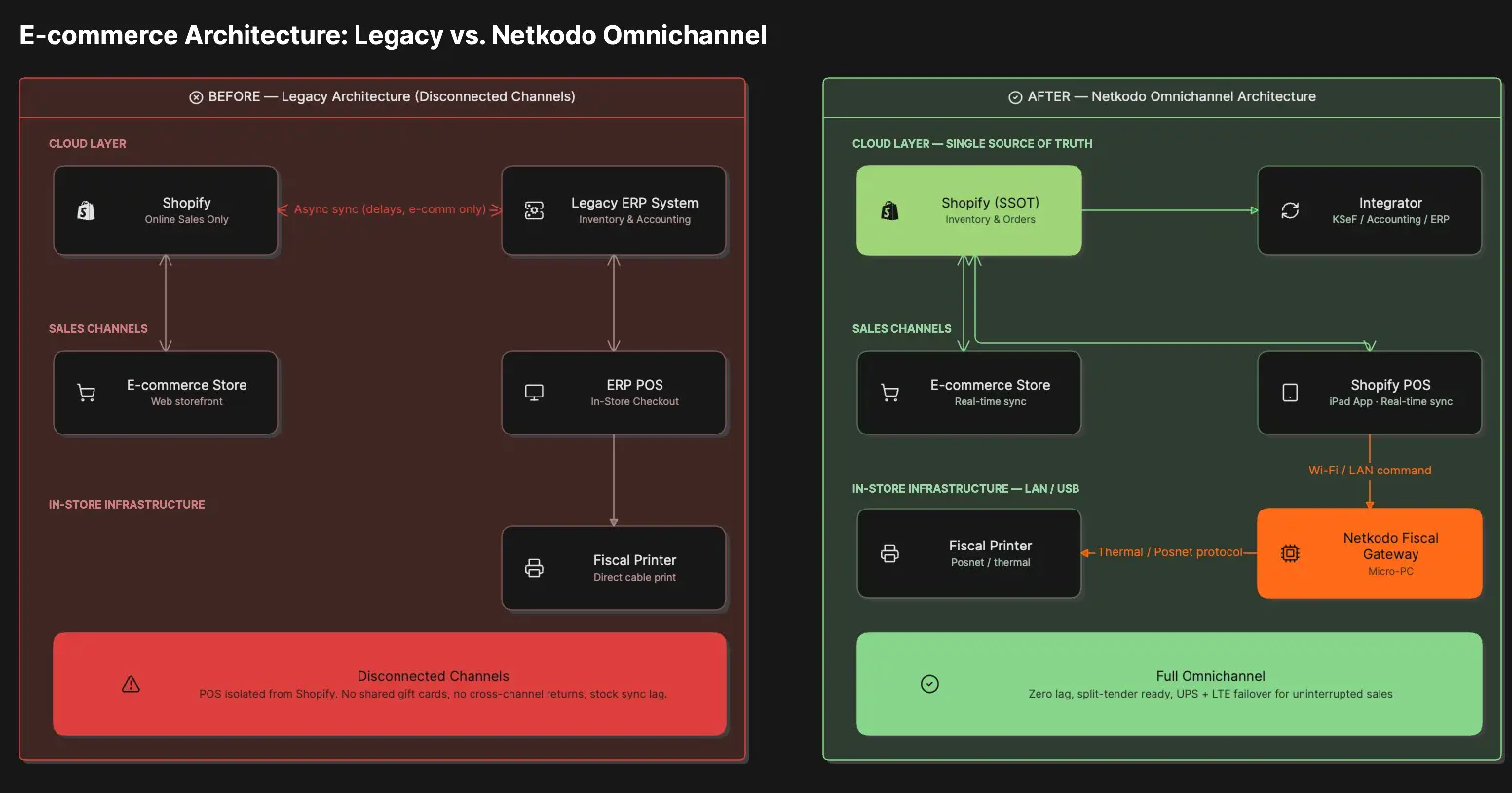
At Netkodo, we decided that Polish retail deserves Enterprise-class architecture. We built Netkodo Fiscal Gateway – proprietary hardware that is an intelligent bridge. It directly connects the iPad with the Shopify POS application to your Polish fiscal printer or payment terminal.
What about GUM certification (Central Office of Measures)? We bypassed this problem architecturally. The Shopify POS application itself, sending the print command, is not a cash register and does not need a GUM certificate. The entire legal obligation (and certificate) rests with the physical fiscal printer already standing in your store. Our Fiscal Gateway does not calculate taxes – it is only a digital translator of the signal between the Shopify world and, for example, Posnet Thermal protocols. Zero legal risk, 100% legality.
How does it work in practice?
- Instant printing: The print command goes from the tablet straight to our device and from it to the fiscal printer. The receipt is printed immediately.
- One source of truth: Shopify becomes the central system for orders from boutiques and ecommerce. ERP is used only for invoicing and advanced back office (KSeF, accounting).
- Split Tender under control: Complicated payments (half the receipt in cash, half with a gift card) are correctly split in the architecture and sent to external systems without accounting errors.
For the most demanding: We know that for premium brands every minute of failure means painful losses. We can equip our devices with a UPS add-on (backup power that keeps them running) and a dedicated LTE modem. If there is a power failure or a failure of the main internet connection in the boutique – your store continues selling offline/LTE, and receipts keep printing without interruptions.
Implementing Shopify POS with Netkodo Fiscal Gateway is the final farewell to compromises. It is full, smooth omnichannel, in which inventory with scanners, cross-channel returns and loyalty programmes work on one engine, exactly as Shopify engineers intended it.
Do you want to see how we remove old ERP from stores and implement modern omnichannel? [Let’s talk about the architecture of your sales – https://cal.com/jarekwozniak/20min]




